Faculty & Staff News
Did You Know Trees Breathe? New Research from Dr. Boko Explains!
Faculty & Staff News
As a child, Dr. Tandeka Boko, Assistant Professor of Biology in the Life Sciences Department at Forsyth Tech, remembers her mother talking to plants. Today, that early curiosity connects her teaching and research in a powerful way. In her role as Visiting Faculty of Berkeley National Laboratory, Dr. Boko translated her childhood love of plants into research on what she calls the “volatile gas language of the big woody plants known as trees”.
Dr. Boko’s research on how trees “breathe” and communicate was recently published by Springer Nature Link. Her paper, “A minor respiratory process with major global implications: Is atmospheric methane oxidation in tree stems driven by stem respiration rather than microbial methanotrophy?” asks a big question with real world impact. Can tree stems do more than simply transport methane (CH₄), a potent greenhouse gas? Can they actually consume it?
“The gas in breaths that we take as humans can be measured and tell a story about what is going on in our body, and this measurement and storytelling can also be done with trees.”
Trees don’t just stand there quietly. They exchange gases as part of their normal metabolism. Their woody stems “inhale” oxygen and “exhale” carbon dioxide, and act as pipelines for transporting methane gas from oxygen-poor soils into the atmosphere.
But that’s not the end of the story
Using high-frequency, real-time measurements, Dr. Boko and her co-authors tracked how gases moved in and out of tree stems across the day, similar to how doctors can monitor a person’s breathing over time to see what is happening inside the body. Or like noticing how our breathing changes from night rest to morning exercise.
So what happened?
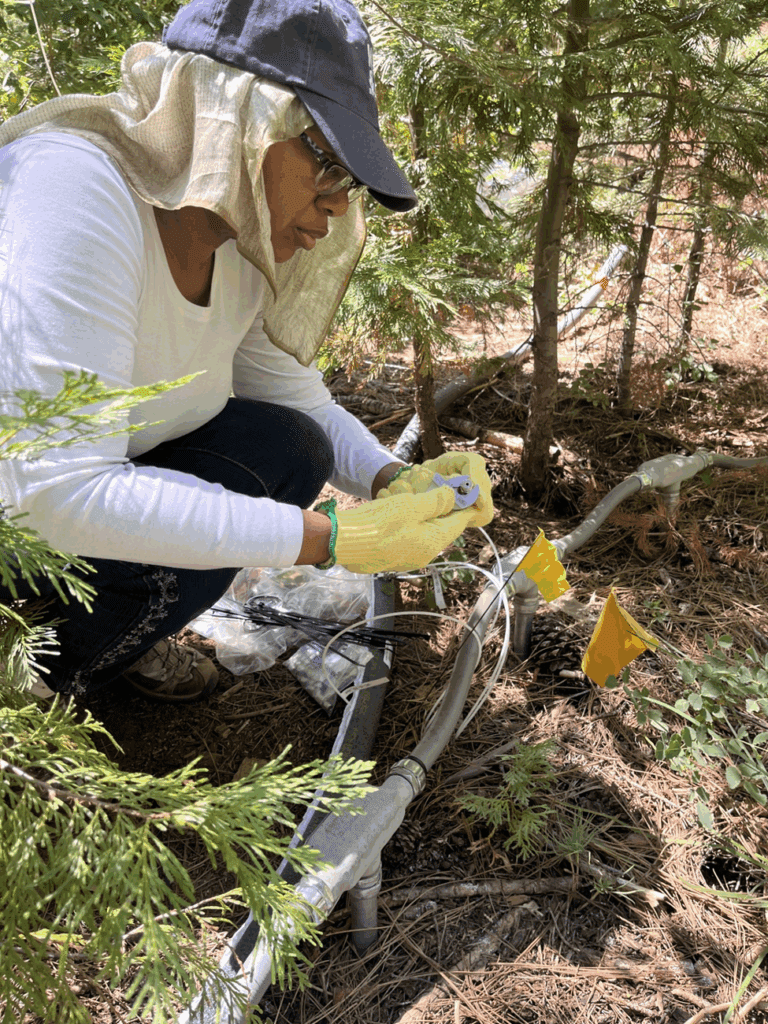
The team observed methane uptake rising and falling alongside oxygen uptake, especially in morning hours when stem respiration increased. That close relationship suggests methane oxidation in stems may be tied to the tree’s own respiratory activity, not only to the widely known methane-eating microbes on bark surfaces.
While the amount of methane a single tree consumes is small, forests cover huge areas. Taken together, widespread methane uptake across many trees could represent a meaningful methane sink, one more piece of the puzzle scientists use to understand and predict changes in climate.
The intersection of research, teaching and learning
At Forsyth Tech, Dr. Boko brings this kind of “science in action” into her classroom. Her student-centered approach focuses on helping learners build confidence, connect ideas and see why biology matters beyond an exam. She uses storytelling to make complex topics feel real and relatable. For example, linking photosynthesis and cellular metabolism to respiration in tree stems, and to what students learn in Anatomy & Physiology about how our bodies take in oxygen and release carbon dioxide.
For those considering community college, Dr. Boko’s story is a reminder that you don’t have to wait for a four-year university to do meaningful science. You can start building skills, asking questions and exploring real-world careers right here where learning connects to the world outside the classroom.
Interested in learning more about how trees breathe? Check out Dr. Boko’s article for more findings here: https://doi.org/10.1007/s00468-025-02689-9 or contact her at: tboko@forsythtech.edu or 336.757.3360.