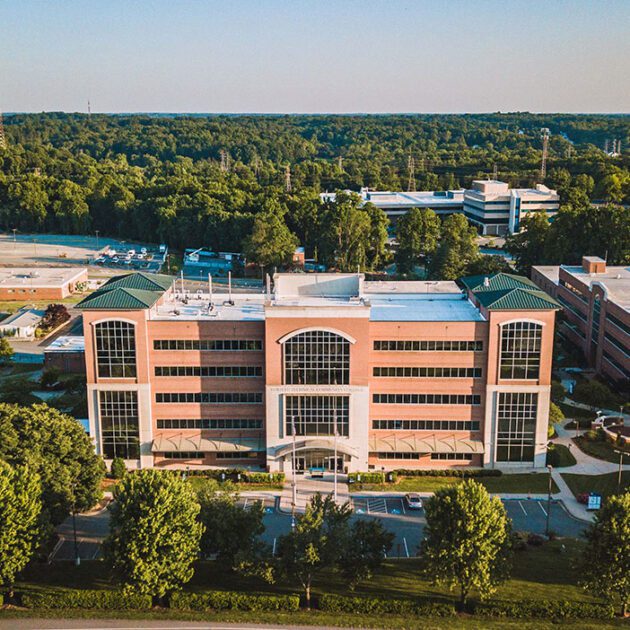
The Jeanne Clery Campus Safety Act (Clery Act) is a consumer protection law that federally mandates all institutions of higher education who participate in the federal student financial aid program to disclose information about crime on Forsyth Tech property and other safety-related information to current and prospective students and employees. The Clery Act affects virtually all public and private institutions of higher education and is enforced by the U.S. Department of Education. Institutions that fail to comply with the Clery Act can be penalized with large fines and may be suspended from participating in the federal financial aid program. The majority of the required Clery Act disclosures and information can be found in the Annual Security Report below.
Annual Security Report
In compliance with the Clery Act, Forsyth Tech prepares and publishes an Annual Security Report. The purpose of this report is to disclose campus crime statistics from the most recent three calendar years, as well as provide information about safety policies and practices intended to promote awareness about safety and security. This report also includes contact information for various campus and community resources related to crime prevention, reporting resources, and survivor assistance.
You may use the link below to access a digital copy of the current report. A hard copy of this report is available upon request by contacting the Forsyth Tech Campus Police Department at (336) 734-7243 or visiting the Forsyth Building located on Main Campus during normal business hours, 8:00 A.M. – 5:00 P.M., Monday through Friday.
Annual Safety ReportDaily Crime Log
The Daily Crime Log provides details about crimes that are reported to the Forsyth Tech Campus Police Department. The purpose of the crime log is to record all criminal incidents and alleged criminal incidents that are reported to Campus Police. Therefore, not all incidents listed on the crime log are included in Clery statistics.
The crime log for the most recent 60-day period is available online or by visiting the Campus Police Department during normal business hours, 8:00 A.M. – 5:00 P.M., Monday through Friday. For information concerning the crime log, or to view any portion of the log that is older than 60 days, please contact the Campus Police Department.
Daily Crime Log
Campus Safety Alerts (TechAlerts)
Forsyth Tech is committed to maintaining a safe and secure environment for its faculty, staff, students, and visitors. The TechAlert system was created to enhance and promote safety on campus by providing the campus community with timely access to important information. The system sends two types of communications to the campus community, “Timely Warnings” and “Emergency Notifications,” as required by the Clery Act.
Timely Warnings are issued when a report is received of certain crimes (see Clery Crime Definitions) on Forsyth Tech-associated property (see Clery Geography), and the reported incident represents a serious or continuing threat to the campus community. In addition to warning community members, these alerts can aid in crime prevention. The decision to issue a timely warning is made on a case-by-case basis, considering the facts surrounding a crime. A timely warning may also be issued for other crimes it deems pose an ongoing threat to the safety of students or employees, regardless of whether it is a Clery reportable crime. Additionally, crimes that are reported to have occurred off campus, but pose an ongoing threat to the safety of students or employees, may result in the issuance of a timely warning.
Emergency Notifications are issued for any significant emergency or dangerous situation occurring on campus that involves an immediate threat to the health or safety of students or employees. The types of emergencies that may initiate a TechAlert include but are not limited to: an approaching hurricane or other extreme weather condition; a structure fire; an outbreak of a serious contagious illness; a natural disaster; gas leak; active shooter or armed intruder; a bomb threat; civil unrest or rioting; an explosion; a terrorist incident; a nearby chemical or hazardous materials spill; or a significant impact power outage. The purpose of emergency notifications is to provide life-saving information and instructions during an active emergency situation.
Campus Security Authorities
Campus Security Authorities (CSAs) are responsible for reporting allegations of Clery Act crimes that are reported to them in their capacity as a CSA. For more information on reporting obligations or to schedule a CSA training for your department, please contact the Clery Compliance Officer.
A Campus Security Authority is anyone who:
- Works for the campus police department or a campus security department or has responsibility for campus security (e.g., individuals responsible for monitoring the entrance into institutional property or someone who works event security).
- Is a designated office/organization/individual to receive reports of criminal offenses from students and employees.
- Has significant responsibility for student and campus activities, including, but not limited to, student discipline, advisor to a registered student organization, and campus judicial proceedings.
CSAs are determined by criteria established in the Department of Education’s Handbook for Campus Safety and Security Reporting. Pastoral and professional counselors are not considered a CSA when acting in their roles as a pastoral or professional counselor.
Please see the Clery Crimes and Clery Geography sections below to learn about crimes that should be reported by CSAs.
In your role as a CSA, if you witness or are told of an incident that is possibly criminal and is related to Forsyth Tech, please report it. You do not need to determine if the incident meets the Clery crime and Clery geography definitions. The Clery Compliance Officer will assess the information provided in the report.
For emergencies or crimes in progress, please contact the Campus Police Department by dialing (336) 734-7911 or 7-9-1-1 from an office phone or landline service or call 9-1-1.
CSAs can use the CSA Reporting Form to report alleged Clery Act crimes.
Clery Crimes
Murder and Non-negligent Manslaughter: The Willful (non-negligent) killing of a human being by another.
Manslaughter by Negligence: The killing of another person through gross negligence.
Rape: Penetration, no matter how slight, of the vagina or anus, with any body part or object, or oral penetration by a sex organ of another person, without the consent of the victim.
Fondling: Touching of the private body parts of another person for the purpose of sexual gratification, without the consent of the victim, including instances where the victim is incapable of giving consent because of his/her age or because of his/her temporary or permanent mental capacity.
Incest: Sexual intercourse between persons who are related to each other within the degrees wherein marriage is prohibited by law.
Statutory Rape: Sexual intercourse with a person who is under the statutory age of consent.
Robbery: The taking or attempting to take anything of value from the care, custody, or control of a person or persons by force or violence and/or by putting the victim in fear.
Aggravated Assault: An unlawful attack by one person upon another for the purpose of inflicting severe or aggravated bodily injury.
Burglary: The unlawful entry of (or attempt to enter) a structure to commit a felony or theft.
Motor Vehicle Theft: The theft or attempted theft of a motor vehicle.
Arson: The willful or malicious burning or attempt to burn, with or without the intent to defraud, a dwelling house, public building, motor vehicle or aircraft, personal property of another, etc.
A hate crime is a criminal offense that manifests evidence that the victim was intentionally selected because of the perpetrator’s bias against the victim. Categories of bias are race, religion, sexual orientation, gender, gender identity, ethnicity, national origin, and disability. In addition to the primary criminal offenses listed above, the following crimes are also classified as hate crimes when there is evidence that the offense was committed with bias against the victim –
Larceny-Theft: The unlawful taking, carrying, leading, or riding away of property from the possession or constructive possession of another.
Simple Assault: An unlawful physical attack by one person upon another where neither the offender displays a weapon, nor the victim suffers obvious severe or aggravated bodily injury involving apparent broken bones, loss of teeth, possible internal injury, severe laceration, or loss of consciousness.
Intimidation: To unlawfully place another person in reasonable fear of bodily harm through the use of threatening words and/or other conduct, but without displaying a weapon or subjecting the victim to actual physical attack.
Destruction/Damage/Vandalism of Property: Willfully or maliciously destroy, damage, deface, or otherwise injure real or personal property without the consent of the owner or the person having custody or control of it.
Dating Violence: Violence committed by a person who is or has been in a social relationship of a romantic or intimate nature with the victim. The existence of such a relationship shall be determined based the reporting party’s statement and with consideration of:
- The length of the relationship,
- The type of relationship, and
- The frequency of interaction between the persons involved in the relationship.
Domestic Violence: A felony or misdemeanor crime of violence committed by:
- A current or former spouse or intimate partner of the victim;
- A person with whom the victim shares a child in common;
- A person who is cohabitating with, or has cohabitated with, the victim as a spouse or intimate partner;
- A person similarly situated to a spouse of the victim under the domestic or family violence laws of the jurisdiction in which the crime of violence occurred; or
- Any other person against an adult or youth victim who is protected from the person’s acts under the domestic or family violence laws of the jurisdiction in which the crime of violence occurred.
Stalking: Engaging in a course of conduct directed at a specific person that would cause a reasonable person to fear for the person’s safety or the safety of others or suffer substantial emotional distress.
Sexual Assault: An offense that meets the definition of rape, fondling, statutory rape, or incest as used in the FBI’s Uniform Crime Reporting (UCR) program. Per the National Incident-Based Reporting System User Manual from the FBI UCR Program, a sex offense is “any sexual act directed against another person, without the consent of the victim, including instances where the victim is incapable of giving consent.”
Any intentional, knowing, or reckless act committed by a person (whether individually or in concert with other persons) against another person or persons regardless of the willingness of such other person or persons to participate, that –
- is committed in the course of an initiation into, an affiliation with, or the maintenance of membership in, a student organization; and
- causes or creates a risk, above the reasonable risk encountered in the course of participation in the institution of higher education or the organization (such as the physical preparation necessary for participation in an athletic team), of physical or psychological injury including –
- whipping, beating, striking, electronic shocking, placing of a harmful substance on someone’s body, or similar activity;
- causing, coercing, or otherwise inducing sleep deprivation, exposure to the elements, confinement in a small space, extreme calisthenics, or other similar activity;
- causing, coercing, or otherwise inducing another person to consume food, liquid, alcohol, drugs, or other substances;
- causing, coercing, or otherwise inducing another person to perform sexual acts;
- any activity that places another person in reasonable fear of bodily harm through the use of threatening words or conduct;
- any activity against another person that includes a criminal violation of local, State, Tribal, or Federal law; and
- any activity that induces, causes, or requires another person to perform a duty or task that involves a criminal violation of local, State, Tribal, or Federal law.
An arrest for Clery Act purposes is defined as persons processed by arrest, citation, or summons. A disciplinary referral is the referral of any person to any campus official who initiates a disciplinary action of which a record is kept and which may result in the imposition or a sanction.
Weapons Law Violations: The violation of laws or ordinances prohibiting the manufacture, sale, purchase, transportation, possession, concealment, or use of firearms, cutting instruments, explosives, incendiary devices, or other deadly weapons. This classification encompasses weapons offenses that are regulatory in nature.
Drug Abuse Violations: The violation of laws prohibiting the production, distribution, and/or use of certain controlled substances and the equipment or devices utilized in their preparation and/or use. The unlawful cultivation, manufacture, distribution, sale, purchase, use, possession, transportation, or importation of any controlled drug or narcotic substance. Arrests for violations of state and local laws, specifically those relating to the unlawful possession, sale, use, growing, manufacturing, and making of narcotic drugs.
Liquor Law Violations: The violation of state or local laws or ordinances prohibiting the manufacture, sale, purchase, transportation, possession, or use of alcoholic beverages, not including driving under the influence or drunkenness.
Clery Geography
Any building or property owned or controlled by Forsyth Tech within the same reasonably contiguous geographic area and used by Forsyth Tech in direct support of, or in a manner related to, Forsyth Tech’s educational purposes; and any building or property that is within or reasonably contiguous to the core campus that is owned by Forsyth Tech, but controlled by another person, is frequently used by students and supports institutional purposes.
Any building or property owned or controlled by a student organization that is officially recognized by Forsyth Tech; or any building or property owned or controlled by Forsyth Tech that is used in direct support of, or in relation to, the college’s educational purposes, is frequently used by students, and is not within the same reasonable contiguous geographic area of the institution.
All public property, including thoroughfares, streets, sidewalks, and parking facilities, that is within the campus, or immediately adjacent to and accessible from the campus. This property is owned by a public entity, such as a city or state government.
Additional Resources
The Forsyth Tech Campus Police Department is a fully sanctioned law enforcement agency. The Campus Police Department is responsible for law enforcement, security, and emergency response at Forsyth Tech. This involves many different services. For more information, please visit the Campus Safety webpage here.
Forsyth Tech is committed to providing its faculty, staff, and students with an education and workplace environment free from any form of unlawful discrimination. The Forsyth Tech community is dedicated to fostering and supporting a culture of mutual respect and communication.
Forsyth Tech does not tolerate and prohibits discrimination or harassment of students and employees based on, or related to, sex (including pregnancy, sexual orientation, and gender identity), race, national origin, religion, age, disability, or other protected categories, classes, or characteristics. Discriminatory behavior is prohibited regardless of the manner in which it is exhibited, whether verbally, in writing, or electronically displayed or conveyed. Individuals who violate these policies and laws are subject to disciplinary action. For more information, please visit the Title IX webpage here.
Counseling Services are available to all students attending Forsyth Tech and are staffed with trained clinicians who are compassionate and willing to help explore concerns and develop ideas for effectively dealing with a difficult situation. For more information, please visit the Counseling Services webpage here.
The mission of the Shugart Women’s Center is to support and enhance the academic, professional, and personal development of all women and individuals who identify as women. The Shugart Women’s Center is committed to promoting equitable opportunities in an inclusive, safe, and supportive environment that values and celebrates the diversity of all women, regardless of race, color, ethnic origin, age, gender, sexual orientation, gender identity, or disability. For more information, please visit the Shugart Women’s Center webpage here.
Forsyth Tech is committed to making everyone in our campus community safe, comfortable, and supported while they learn and work. We want to ensure that everyone remains safe and free from harassment, discrimination, retaliation, and violence. We depend on community members like you to identify and report any issues of concern so we can address them and provide impacted students and employees with support. To make a report or file a grievance, please visit the Report It webpage here.
Forsyth Tech does not tolerate hazing in any form. Hazing is prohibited for any Forsyth Tech recognized or sanctioned organization, student, or other person associated with an organization operating under the sanction of or recognized by Forsyth Tech. For more information surrounding hazing at Forsyth Tech, please visit the Hazing Resources & Prevention webpage here.