Faculty & Staff News
When Support Can’t Wait: Shanta Reddick Recognized as Financial Health First Responder Award Winner

Faculty & Staff News
At Forsyth Tech, some of the most important work happening on campus isn’t in a classroom. It’s happening in the moments when a student is on the verge of stopping out—and someone steps in to help them stay.
That someone is Shanta Reddick.
Reddick, Director of Forsyth Tech Cares & Adult Learner Success, has been named a Financial Health First Responder Award winner. The recognition honors individuals who respond quickly and effectively when financial challenges threaten someone’s stability. It’s a fitting acknowledgment for someone whose work centers on making sure students don’t have to choose between life’s basic needs and their education.
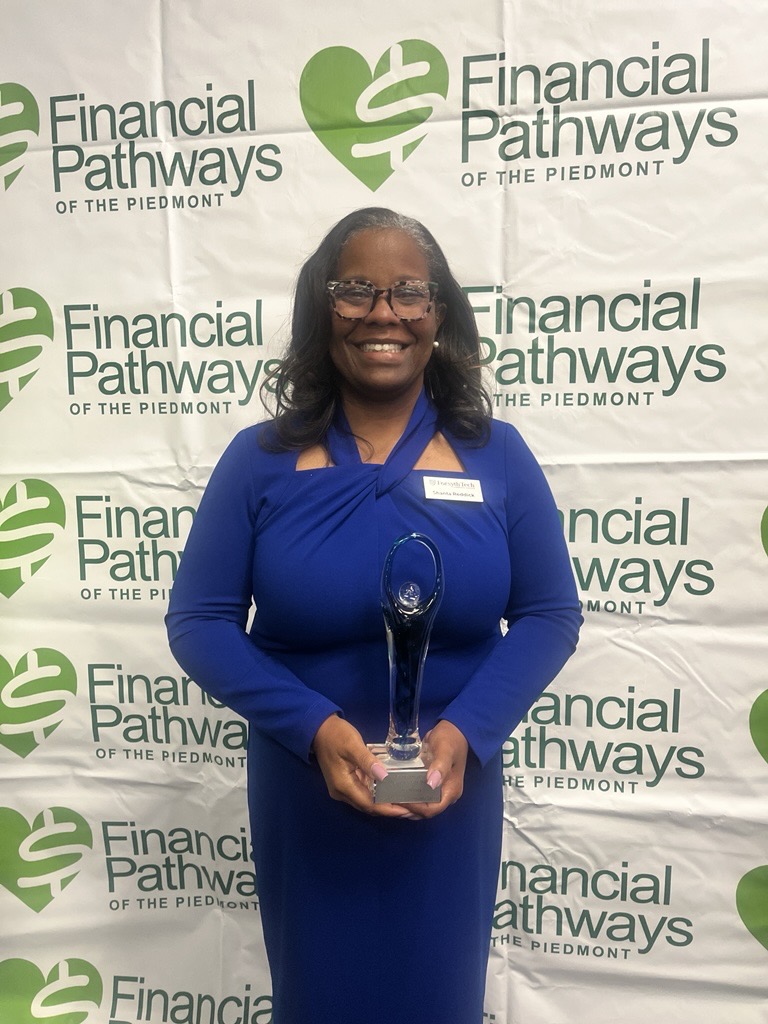
Since joining Forsyth Tech in 2020, Reddick has helped shape Forsyth Tech Cares into a comprehensive support system that meets students where they are. Her approach is grounded in a simple idea: when financial barriers are removed, students have a real chance to succeed. Under her leadership, students have been able to access emergency rent and utility assistance, childcare funding, food through the Connect Pantries, transportation support, and financial literacy programming designed for women who are heads of household.
But what sets her work apart is not just the range of services. It is how those services are delivered. Reddick and her team respond in real time, often stepping in during moments of crisis when a student is unsure how they will make it through the week, much less the semester. One student parent who had fallen months behind on childcare payments described how quickly help came. “Next thing I know, they were like, ‘Your balance is being paid.’ It’s as streamlined as that.”
That moment meant more than financial relief. It meant staying enrolled while supporting a family of six. Another student, facing the possibility of losing power and water, shared the weight that had been lifted. “I was stressed and worried about how I was going to keep my power and water on… I was able to get the help I needed… This was such a great relief of stress.”
These stories are common in Reddick’s work. Students come in facing urgent challenges, and they leave with a path forward.
What makes that possible is her focus on long-term stability rather than short-term fixes. Reddick does not simply connect students to resources. She helps them build plans that allow them to redirect their limited income toward their education instead of constant crisis management. Childcare becomes a way to stay enrolled. Food access allows families to shift spending toward transportation and tuition. Emergency support becomes a bridge that keeps students moving instead of stopping.
The results are clear. Students who receive support through Forsyth Tech Cares are more likely to complete their courses, and when financial barriers are addressed, their academic outcomes align with their peers. The difference is not ability. It is access.
For Reddick, this work is deeply connected to student parents, a group that often faces the steepest challenges. At Forsyth Tech, they make up a large portion of the student population, yet their needs have historically gone unmet in higher education systems. Reddick has worked to change that. She led the creation of the Student Parent Advocacy Resource Center, known as SPARC, after recognizing how many students were balancing coursework with raising children.
Her leadership in this space has gained national attention. Reddick is widely recognized as a thought leader when it comes to supporting student parents, helping to shape conversations about what colleges can and should be doing to help this population succeed. Through Forsyth Tech’s participation in New America’s Child Care for Student Parents Cohort—one of only five colleges selected nationwide—she has contributed to a growing body of work focused on improving outcomes for student parents.
She has also taken that work beyond campus, advocating at the federal level for continued funding through the Child Care Access Means Parents in School program. These efforts reflect a broader commitment to ensuring that student parents are not an afterthought, but a priority.
Part of what makes Reddick’s approach effective is her ability to build strong partnerships across the community. She has worked closely with organizations like Financial Pathways of the Piedmont, Second Harvest Food Bank, HOPE Winston-Salem, and Truliant Credit Union to expand the support available to students. These partnerships allow Forsyth Tech to offer more than a single solution. They create a network of support that meets students’ needs from multiple angles.
She has also helped introduce new ways of delivering services, including digital pantry access and flexible financial action plans for students who may not qualify for traditional assistance but are still facing hardship. These innovations make it easier for students to get help when they need it, without added barriers.
The impact of this work is not limited to individual students. When student parents are able to complete their education, the benefits extend to their families and to the broader community. Higher earning potential, increased stability, and improved outcomes for the next generation all follow. The ripple effect is real, and it starts with moments where someone steps in and says, “We can help you stay.”
Students feel that difference. One student who had previously left a four-year university because of childcare challenges described reconnecting with her education after working with Reddick. “She gave me that fighting chance.” Another reflected on what it means to have consistent support. “Being able to have somebody in your corner… not just there to support you financially but emotionally… makes being a student parent here so different.”
That sense of support changes how students see their future. It turns uncertainty into possibility.
The Financial Health First Responder Award recognizes individuals who respond in critical moments and help others regain stability. Reddick embodies that role fully. She acts quickly, builds systems that last, and keeps students moving forward when circumstances might otherwise stop them.
At Forsyth Tech, her work continues to shape how the college supports its students. Beyond campus, her voice is helping influence how institutions across the country think about student parents and financial stability.
Her impact can be measured in data, in partnerships, and in programs. It can also be seen in something less measurable but just as important—the relief a student feels when they realize they don’t have to leave.
That moment is where Reddick’s work begins.